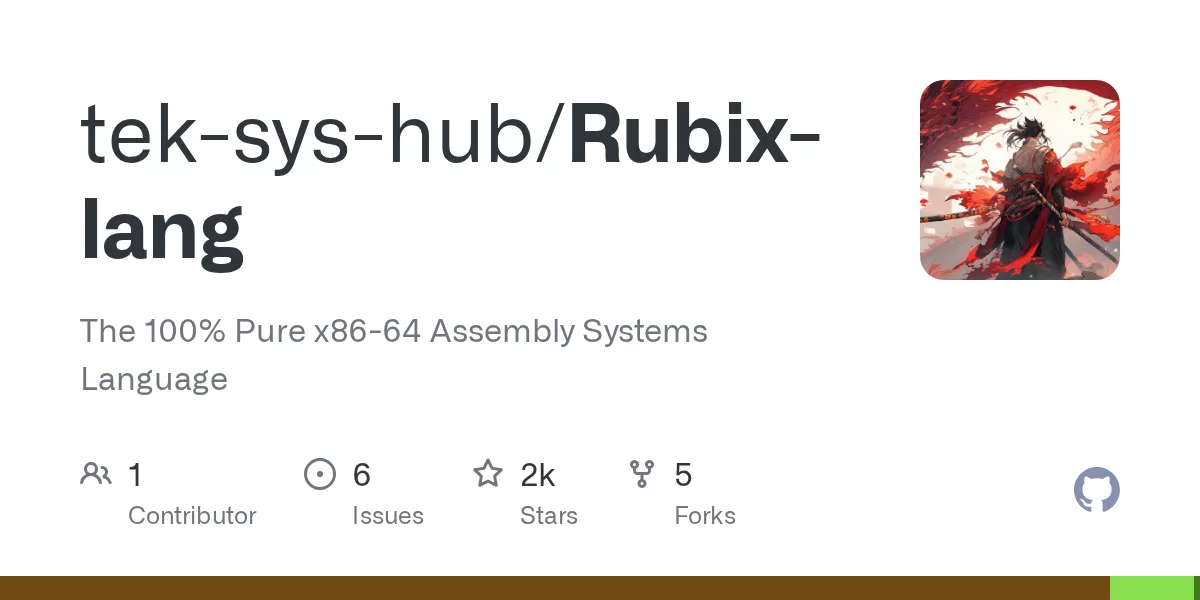
Rubix is an open-source systems programming language whose compiler is written entirely in x86-64 assembly, according to its GitHub repository. The project's README says the compiler is about 42 KB and produces standalone Linux ELF64 and Windows PE64 executables without libc or LLVM. As of 23 October 2026, GitHub listed 1,906 stars and an MIT license.
What does Rubix produce and how does it compile?
Rubix compiles its own .ix source files directly into machine code, with no intermediate toolchain. According to the README, the output is a standalone executable with no dependency on libc, musl or any C runtime. On Linux, the generated programs call the kernel directly through syscalls. On Windows, they locate kernel32.dll by walking the Process Environment Block in memory, so the build does not need import libraries or MinGW.
The README also says the Linux and Windows executables can be built on a Linux machine, which means the Windows target does not require a Windows development setup.
What the language supports today
The README lists a set of core features. These are the project's own description, and the excerpt does not show test output for each one.
- for and while loops with break and continue
- Heap allocation with alloc and free, backed by a 64 KB arena sub-allocator
- Structs with heap instantiation and field mutation
- 64-bit floating-point values with SSE2 arithmetic
- Dynamic arrays and array literals
- Function calls with more than six parameters, using stack spills
- Multi-file imports and an embedded standard library for file I/O, strings and math
- Integer overflow detection that stops the program
Who it is for and where it falls short
Rubix suits readers who want to study a compiler written in plain assembly, or who need very small native binaries and have no interest in a large toolchain. The README says the primary compiler is about 3,500 lines of GNU x86-64 Intel-syntax assembly and passes 19 test suites. The source does not say how many people use it in production.
Several limits are clear from the source. The self-hosting compiler, written in Rubix itself, is described as an early prototype of about 1,000 lines, and full self-hosting is still tracked in Issue #1. The README gives prebuilt binaries only for Linux x86-64. Its claims about the platform entry points and the Windows resolver say these are verified on host systems, but the excerpt does not name those hosts. The README also lists macOS system-call numbers, but it does not say whether macOS is a finished target.
The repository had 5 forks and its last commit was pushed on 22 October 2026, according to GitHub. Those figures suggest recent activity, but they do not show how many contributors maintain the project.
Who should not use it yet?
Teams that need a stable language with documentation, libraries and a long track record should not adopt Rubix on the strength of this README alone. The source does not provide release notes, a version history or a roadmap beyond the self-hosting issue.
How do you try it first?
The README's quickstart has three steps. The first step is to build the compiler or download a prebuilt Linux binary. The second is to compile and run a sample program. The third is to run the full test suite. The excerpt does not include the exact commands, so read the repository's quickstart before you start.
- Install GNU as and ld from binutils, the only listed prerequisite.
- Build rubix_compiler from source, or download the prebuilt Linux x86-64 binary from the GitHub Releases page.
- Compile a sample .ix program and run it, then run the test suite to check the build on your machine.
How does it compare with C, Zig and Rust?
The README positions Rubix against C, Zig and Rust. It claims compilation takes under 1 ms, and it says the Zig, Rust and Clang toolchains weigh between 100 MB and 1.5 GB. Those numbers are the project's claims. The excerpt includes no benchmark results and no measurement method, so readers should check them before relying on them.
The concrete difference the README draws is in the build chain. Rubix does not use LLVM or Clang, and its compiler is written in assembly rather than in a higher-level language. Established toolchains such as Rust and Zig offer far larger ecosystems, and the README does not claim Rubix matches them.
Bottom line: Rubix is worth a look if you want to read or experiment with a small, assembly-based compiler on Linux. Do not treat its size and speed claims as settled, and do not use it for production work until you have checked the test suite and the project's activity yourself.
Source and verification: This article is based on the README of the GitHub repository tek-sys-hub/Rubix-lang, as shown on the project page. The excerpt does not give a publication date, so the page was read as published on 23 October 2026. Star count, fork count, license, main language and last commit date come from the GitHub API as of 23 October 2026. The performance and size claims are the project's own and have not been independently verified.
Frequently asked questions
Does a Rubix program need libc to run?
According to the README, produced binaries have zero dependency on libc, musl or C runtimes. The Windows path also does not need import libraries or MinGW.
Is Rubix ready for production use?
The source does not make a stability claim. It describes the primary compiler as complete and passing 19 test suites, and it calls the self-hosting compiler an early prototype.
What license does Rubix use?
Rubix is released under the MIT License, according to the README and GitHub.
Related: Awesome Reverse Engineering: A Curated Map of Tools and Courses · CleanYourTV: Debloat Android TV Over Wi-Fi and Get a New Home Screen





Comments (0)