This week's GitHub projects cluster around three themes: AI coding tools, developer utilities and tools for everyday work outside the editor. Two entries stand out for AI-assisted work. Anatomy turns a technical concept into an interactive machine figure, and Coucou keeps coding agent sessions visible from the top of the screen and lets developers approve requests from anywhere.
Other entries address long-standing friction. omdrop-owl brings AirDrop-style transfers to Linux laptops with non-Apple Wi-Fi hardware, Octosmith manages repository settings as code, and CADCraft recreates an AutoCAD-style drafting workflow in Rust. The blurbs below describe only what each article reports.
1. Anatomy: A Claude Code Skill That Builds Isometric Machines to Explain Ideas
Anatomy is an open Claude Code skill from GitHub user wheresryan22. Instead of drawing a diagram, it has Claude imagine a real machine that works on the same principle as a technical concept, then builds that machine as an interactive isometric figure. The repository, wheresryan22/anatomy, suits writers of documentation, articles and landing pages who want visuals that explain how an idea works.
Best for: Writers and teams producing technical documentation or landing pages
2. Coucou: Open-Source Mac Notch Tool Watches AI Coding Agents
Coucou is an open-source, MIT-licensed tool that shows AI coding agent sessions in a compact companion called Mochi. On a Mac it sits in the notch; on Windows and Linux it uses a bar at the top of the screen. It tracks agents such as Claude Code, Codex and Cursor and can ask for approval of actions without returning to the terminal.
Best for: Developers running several coding agents who often step away from their desks
3. Codex on Crack Lets You Mix Claude and DeepSeek Models in Codex
Codex on Crack is a GitHub repository, previously named Astra Flash Orchestrator and currently a preview release, that lets Codex coordinate several configured AI models in one session. A lead model can plan a task, hand the implementation to another model and then review the output, without leaving Codex. It suits developers who want different models for planning and building and who find switching tools hard to track.
Best for: Developers combining several AI models inside one Codex workflow
4. ClearAI Plugin Builds Verified Domain Ontologies From Research
ClearAI, in the repository Clearailhc/clearai-dsh, is an ontology-first preset for the DSH agent host. It builds a browsable domain ontology from research, but only from claims that pass an evidence check. The project is a response to knowledge graphs that keep adding links without verifying them. It suits researchers who want an ontology limited to verified claims.
Best for: Researchers who need a verified record of AI-assisted findings
5. Octosmith Brings Configuration as Code to GitHub Repositories
Octosmith is an open-source toolkit from the account Kralizek for defining, validating and reconciling GitHub repository configuration as code. Teams describe the repositories they manage, assign each to a template, review the changes needed to reach that target state, and apply them through a command-line interface or GitHub Actions. It suits organizations that manage many repositories with their own access and settings.
Best for: Organizations managing many repositories with consistent settings
6. FilzaFiles: A Lightweight Java Library for File Operations
FilzaFiles is a lightweight Java library at version 0.1.0 that wraps everyday file tasks. It covers copying, moving, deleting and backing up files, counting words and lines, replacing text, searching directories and inspecting metadata. It is released under the MIT License and is not yet on Maven Central. It suits Java developers who want fewer repetitive helper methods in their own code.
Best for: Java developers who write repetitive file-handling code
7. AirDrop on Linux: open-source omdrop-owl targets non-Apple Wi-Fi cards
omdrop-owl is an open-source project on GitHub, published on 11 October 2026, that lets iPhones send files to Linux laptops over AirDrop even when the Wi-Fi hardware is not Apple's. It acts as a radio backend for the existing omdrop tool and supplies AWDL, Apple's Wireless Direct Link, in userspace through OWL. It suits Linux users with non-Apple machines who want cable-free transfers without cloud accounts.
Best for: Linux users with non-Apple laptops who want AirDrop-style transfers
8. CADCraft: Open-Source, Rust-Built AutoCAD-Style Drafting App
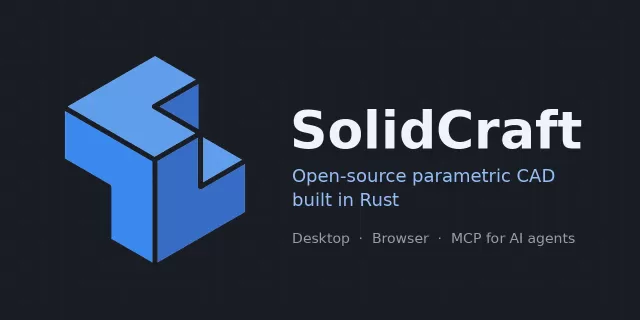
CADCraft is a free, MIT or Apache-2.0 licensed drafting app written entirely in Rust, from the ArtCraft team. It is a clean-room reimplementation of the AutoCAD workflow, meaning its code was written independently rather than copied. It runs natively on macOS, Windows, Linux and FreeBSD, and in a web browser through WebAssembly. It suits people who want a familiar drafting workflow across desktops and browsers.
Best for: Drafters who want an AutoCAD-style workflow on several platforms
9. Bandstand: Open-Source Setlist and Chord Chart Tool for Bands
Bandstand is a self-hosted, Docker-deployed band management tool released under AGPL-3.0. It brings chord charts, setlists, offline stage mode and rehearsal scheduling into one place, instead of scattered phone notes, shared documents and group chats. Each band runs its own copy on a home server or a small cloud machine. It suits amateur and semi-professional bands that want their own setup and a demo with fake data first.
Best for: Amateur and semi-professional bands wanting self-hosted setlists and charts
The takeaway
If you maintain several repositories or run multiple coding agents, start by reviewing Octosmith and Coucou. Before adopting any project from this list, check its licence, README and current release status in its GitHub repository.



Comments (0)