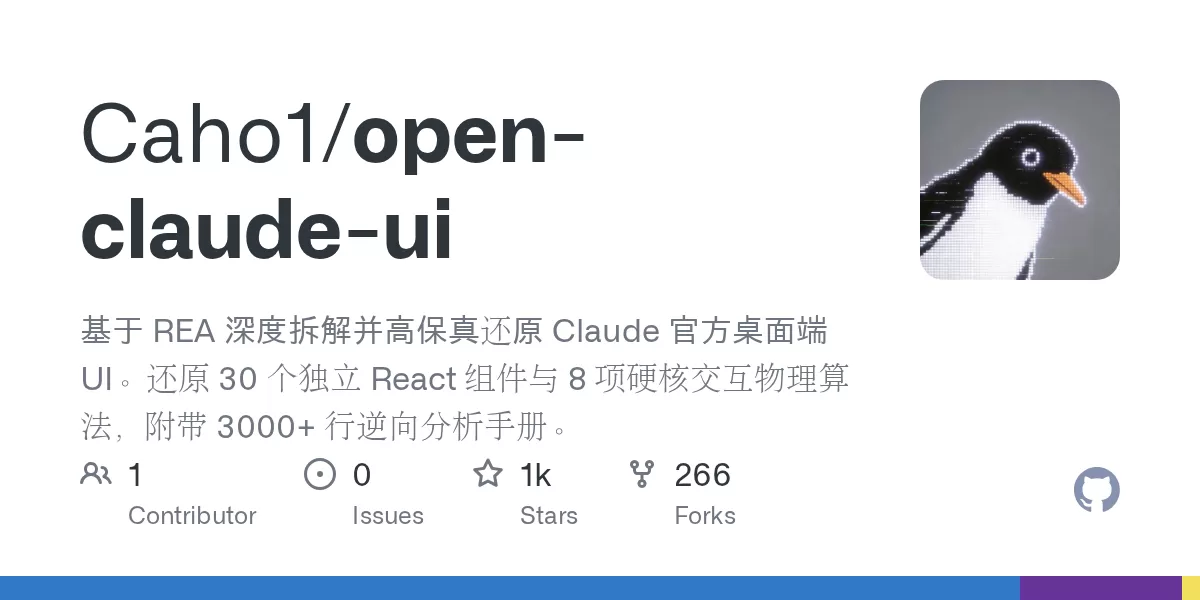
open-claude-ui is an open-source project on GitHub, maintained by the repository owner Caho1, that rebuilds the user interface of Anthropic's Claude desktop app with React components. According to the project's README, as summarised on GitHub, it includes 30 standalone modules, eight interaction algorithms and a reverse-engineering manual of more than 3,000 lines, released under the MIT License.
What does open-claude-ui include?
The repository bundles a design token layer, a set of pure CSS styles and a library of 30 standalone modules. The README says 11 of them are basic controls such as buttons and segmented selectors, while the other 19 are architectural modules and React Hooks that handle more complex behaviour.
The project also ships an offline Storybook in a single HTML file. Users can open it directly in a browser to preview components and animations without running a development server. The README lists 183 design tokens that can be used with or without React or Tailwind CSS.
How was the interface reverse engineered?
The author says the analysis relied on REA, short for Reverse Engineer Anything, a multi-platform reverse-engineering framework. The README credits REA with static AST parsing, closure-based deobfuscation and runtime tracing, which were used to unpack a production archive and recover low-level constants.
The project presents this approach as a contrast to guesswork. The README states that component specifications, damping constants and shader keyframes were derived from decompiled front-end code. The repository alone cannot independently verify those claims, so readers should treat the figures as the author's reported findings.
Which interaction algorithms does the project document?
The README describes eight algorithms. They include a seven-stop non-linear fade mask for scroll edges, which the author says is designed to avoid colour banding on high-density screens, and a microphone noise floor set at 8 percent to filter out background hum.
Other entries cover an IME composition guard that stops the Enter key from sending a message while a Chinese, Japanese or Korean candidate is being confirmed. A 150-millisecond cooldown is described as a way to stop streaming output from pulling users back to the bottom of a conversation, and a transparent overlay prevents iframes from swallowing pointer events while a panel is dragged.
The manual, which the README says runs to more than 3,000 lines across 31 core subsections, records the source locations for these findings. That level of documentation is the project's most distinctive feature, according to the README itself.
How can developers get started?
The quick start section explains that developers can import the core stylesheet or the pure CSS version of the tokens into any web project, whether or not they use React. Tailwind users can extend their theme configuration with the project's values.
The README excerpt does not list runtime requirements or version numbers for dependencies, so anyone planning to install the package should check the full repository first. The project's main language is TypeScript, according to GitHub.
The README also includes guidance for AI coding assistants. It names tools such as Cursor, Claude Code and GitHub Copilot and points them to an AGENTS.md file that contains the design tokens, spring-physics choices and quality checks the project expects.
What are the licence and copyright limits?
The project is released under the MIT License. The README says it does not distribute proprietary binary assets such as commercial fonts or recorded audio. Instead, it uses system font fallbacks and sound effects synthesised with the Web Audio API.
The licence section adds that the decompilation research and code reproductions are intended for learning, research and engineering exchange. That is a narrower statement than the MIT grant itself, so anyone reusing the code should read both sections before adopting it.
What comes next for the project?
GitHub's API data, retrieved on 20 October 2026, shows 1,258 stars and 266 forks, with the most recent commit pushed on 19 October 2026. Those figures indicate interest, but stars do not measure code quality or accuracy of the reverse-engineering claims.
The README also contains a section on a Claude Desktop 2.0 release, labelled v2.37337.1, covering architecture changes and a reference implementation. Whether the author keeps extending the analysis as the desktop app changes will determine how useful the repository remains for front-end developers.
Frequently asked questions
Is open-claude-ui an official Anthropic product?
No. The README describes it as an independent open-source reproduction built through reverse engineering, and it thanks Anthropic's design and front-end team for inspiration.
What licence does open-claude-ui use?
The project is released under the MIT License, according to its GitHub page.
How many components does open-claude-ui provide?
The README lists 30 standalone modules: 11 basic atomic controls and 19 architectural modules with React Hooks.
Related: Awesome Reverse Engineering: A Curated Map of Tools and Courses · Rubix: A Tiny x86-64 Assembly Language Without libc

Comments (0)