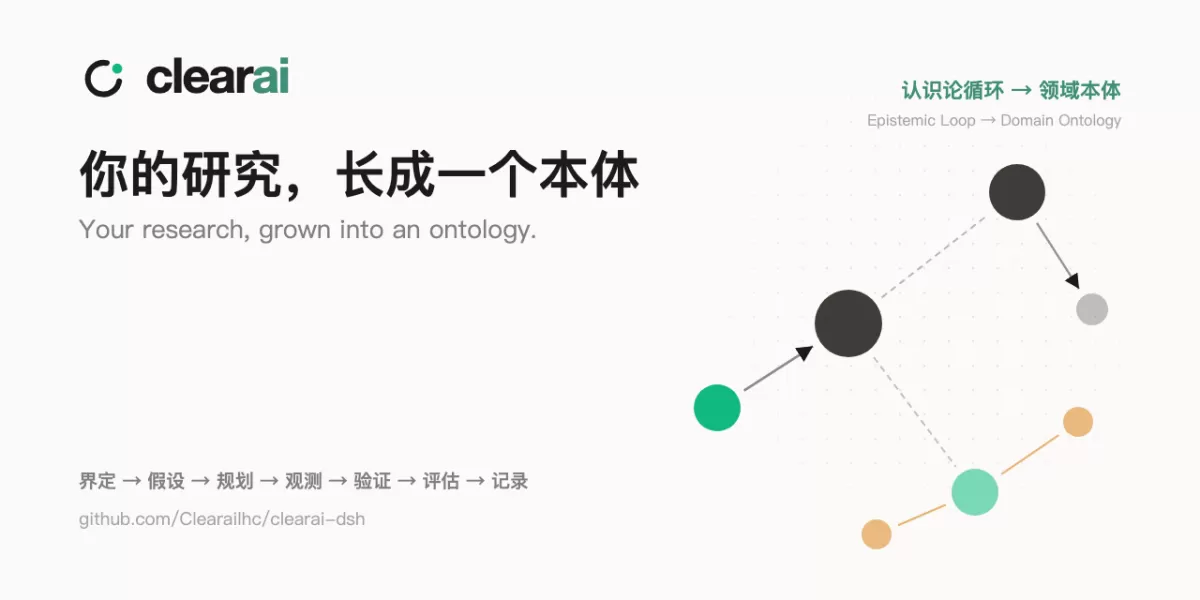
A new open project on GitHub is trying to change how AI research sessions record what they have actually learned. ClearAI, published in the repository Clearailhc/clearai-dsh, is an ontology-first preset for the DSH agent host. Its developers say it turns research into a browsable domain ontology, but only for claims that have passed an evidence check. The project page, dated 11 October 2026, presents the tool as a response to knowledge graphs that keep adding links without verifying them.
What the system produces
ClearAI is built around two ideas. The first is the domain ontology, which the project treats as the main output that users keep. It holds the project's own vocabulary, including concepts, predicates, value forms and units. It also holds established knowledge entries and graphs that show both how a field is structured and which entities have been verified.
Each established entry states its boundary, its support level and its evidence chain. According to the GitHub page, this explicit boundary is what allows an entry to be cited safely later. Conflicting conclusions are not hidden either. The system flags them automatically, and the decision to retract or keep a conflicting reading rests with the user.
The second idea is the epistemic loop, the process that produces the ontology. The project's description of the loop runs from a question to an ontology of the relevant quantities, then to candidate hypotheses with predictions, then to a test that could fail, then to evidence, a bounded conclusion and finally growth into the ontology. The developers state that every edge in the graph must be tested by evidence and independent evaluation.
How the epistemic loop differs from typical agent workflows
The GitHub description contrasts ClearAI with other knowledge graph tools, which, in the project's words, pile up edges through extraction and assertion. In ClearAI, an edge has to be earned through the loop. The difference is in what the agent is asked to track. Many agent loops only check whether a task is finished. The epistemic loop also tracks what makes a conclusion trustworthy.
Several rules shape the process, as the project describes them:
- The ontology comes first. The quantities a question involves, how each is measured, how the reading is checked and how the quantities affect one another are written together at the framing stage.
- Candidates must compete. Each question lists at least two candidate hypotheses. Before each step, the model writes a prediction for every candidate. If a step predicts the same outcome for all of them, the system flags that the step cannot tell them apart.
- Anomalies need a destination. A reading that does not fit the prediction or the ontology must be explained, ruled out with a reason, or written into the answer. If it touches an established fact, that fact returns to awaiting check.
- Answers have four parts. Each answer lists its conclusion, its basis, its open points and the decisions left to the user.
The goal cannot be marked as achieved while a candidate under examination or an open unexplained item is missing from the answer. The project also says the state of the session is derived from the session record itself, with no separate store. The tools available to the model include no field in which it could declare a step complete. A goal is closed only after independent evaluation.
What ClearAI does not claim
The developers are careful about scope. The project says ClearAI does not claim recursive self-improvement. It describes itself as providing the epistemic substrate that a self-improving system would need. Goal continuation, subagents, user questions, deliverable cards and file history all come from the DSH host itself. ClearAI adds the epistemic contract, the domain ontology and the presentation layer.
Installation and requirements
ClearAI requires DSH 0.2.0-rc.2 or later. The project says it has been verified against 0.2.0-rc.2 and also checked against 0.2.1-alpha.1. Hosts older than 0.2.0 are no longer supported.
The recommended route is to install the plugin from the sidebar's Plugins page and pin the version, currently 0.5.3. The page explains why pinning matters. Recent pnpm releases hold back newly published versions by default, and an unpinned package name can silently resolve to the previous release. The DSH plugin manager does not detect this downgrade, so the install appears successful even when it is not the version requested. The project offers three ways to avoid the problem:
- Pin the version, as the recommended command does.
- Exempt the package once in the profile's pnpm-workspace.yaml file, after which a bare package name works.
- Use the one-command installer, which resolves the current release and pins it automatically.
Installing from source is possible but not the normal path. Because git fetches source code rather than prebuilt artifacts, pnpm will require an explicit build permission, which lets the package's code run on the user's machine at install time. The project advises granting that only after reading the source and pinning a commit. After installation, the user restarts the DSH web interface, opens a new session and switches the mode from Standard to ClearAI at the top of the screen. Ordinary questions work as usual. Once a goal is set, the system enters knowledge mode on its own.
Early results against the bare model
The project includes an A/B comparison with the same underlying model, the same tools and the same budget. One arm ran with ClearAI and the other without it, on identical tasks with planted traps, and the outputs were graded blind. The developers stress that these are early development-set results for version 0.5.0. The developers wrote the tasks, the sample is small, and the results are not a formal validity study. A comparison for version 0.5.1 is not yet complete.
In the reported results, both arms noticed when a reference reading disagreed with their work. The difference lay in what happened next. With ClearAI, the model wrote a prediction before acting, and a missed prediction had to be explained, ruled out or passed to a person. An independent evaluator then rechecked the raw data. Lessons from earlier tasks, once checked, were cited when later tasks wrote their predictions.
Exploration depth did not improve for either arm. Both found recipes that fell equally short of the true optimum, and neither identified a coupling between temperature and a second factor. ClearAI also cost about 2.2 times as many tokens. The project says the candidate hypotheses, per-candidate predictions and stop checks planned for version 0.5.1 are aimed directly at that shortfall.
Demonstration sessions
The project points to two real-model sessions run end to end without user intervention. The first reviewed literature on JEPA world models, ran a toy experiment judged by an independent evaluator and produced an ontology of 21 concepts, 8 relations and 27 entities. The second examined whether the Navier–Stokes problem had been solved. It refuted two popular claims, kept both refutations on record, handled an intake rejection and produced an ontology of 24 concepts, 13 relations and 59 entities. The project's documentation also notes that one refuted judgment stopped at the test stage, and the record preserves the reason.
The project's documentation also lists known gaps, including features not yet implemented and parts not verified in a real browser. Readers evaluating the tool should consult that list before relying on it.
Outlook
ClearAI is a local-first tool, and its design is aimed at researchers and teams who need claims they can cite and audit later. Whether its approach holds up under wider testing remains open, and the developers say so themselves. The next comparison, the planned candidate hypothesis features and the status of the browser checks will show whether the epistemic loop can deliver more than a more disciplined record of what was tested. For now, ClearAI offers a concrete example of an AI agent that treats an unverified edge as something to be earned rather than assumed.
Related: Free DeepSeek Models Plugin Claims Uncapped Access, No Sign-Up · Open-Source n8n Bot Calculates Czech Tax on Broker Investments





Comments (0)