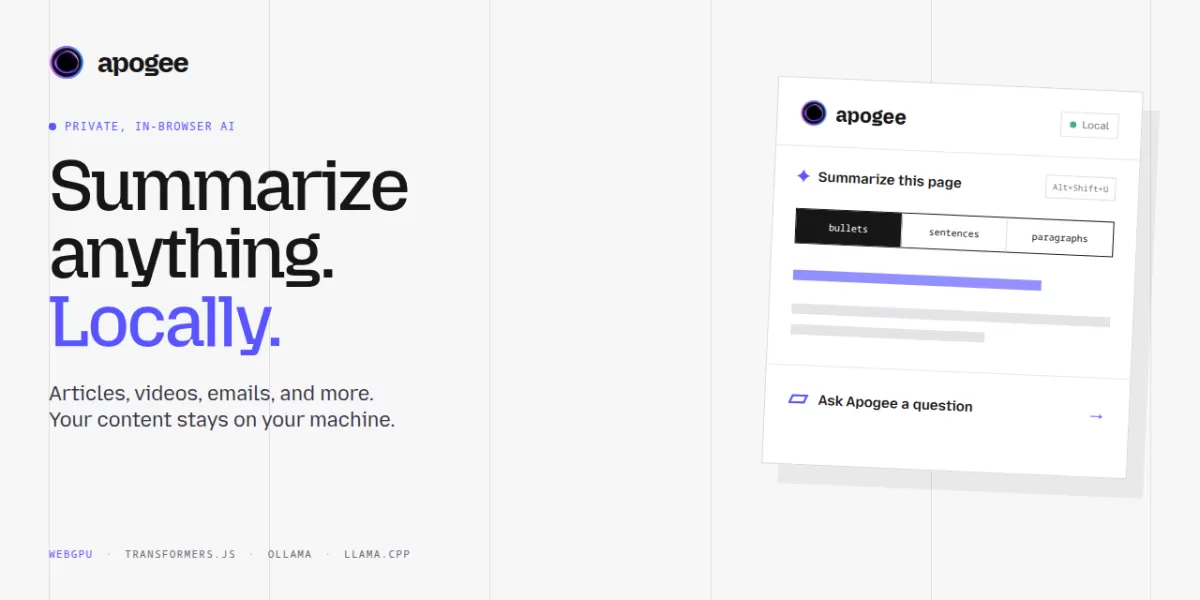
A new browser extension called Apogee is drawing attention among developers and privacy-minded readers. Its project page on GitHub describes it as a private AI summarizer that condenses articles, videos, PDFs, DOCX files and pasted text directly on the user's machine. Unlike many AI tools that send content to remote servers, Apogee is designed to run without a backend, without API keys and without any cloud upload.
How the Tool Works
According to the project's GitHub page, Apogee runs entirely inside the browser. It can use the graphics processor through WebGPU, which is available in Chrome, Edge and other Chromium-based browsers. Where WebGPU is not available, it falls back to the processor through WebAssembly, a technology the project says now works on most machines.
WebAssembly is the default on Firefox and an optional fallback on Chromium browsers. The project positions it as the route for computers that lack WebGPU support. In both cases, the user installs the extension and starts summarizing without creating an account.
Power users have a further option. Apogee can connect to a local Ollama instance running on the user's own computer, reached through the loopback address 127.0.0.1. It can also connect to a llama-server that the user runs independently. This allows larger models than the in-browser options, while keeping the data on the user's own hardware.
Getting started
The project page lists a simple workflow. Users install Apogee from the Chrome Web Store or from Firefox Add-ons. They then open a web page, video, PDF or DOCX file, or paste text into the Apogee popup, choose a summary format and select Summarize.
The first run downloads the chosen model to the browser. Once cached, models can run offline. For larger models, the page explains that users can set up Ollama or llama.cpp in the Settings menu.
Where the Idea Comes From
The project's GitHub page states that Apogee was inspired by Orbit, an experimental browser-based page summarization project from Mozilla. Orbit has since been discontinued. According to the Apogee page, Orbit relied on central API servers and stored summaries on those servers, a design that raised privacy concerns.
Apogee is presented as a response to those design choices. Its developers say the tool is local-first. Tokenization, inference, retrieval and caching all take place on the user's device. Page content, transcripts, files and summaries are not sent to cloud APIs. The project also states that there is no Apogee account system, subscription, telemetry service or backend.
This approach reflects a broader shift in how people use AI tools. Many widely used assistants depend on remote processing, which means users must trust a provider with the text they read and write. Local processing removes that dependency, though it places demands on the user's hardware and, in the case of larger models, may require additional setup.
Features Beyond Basic Summaries
The project page lists a wide set of features. Article extraction uses Readability along with site-specific extractors for sources including Wikipedia, GitHub, Reddit, Hacker News, Bluesky, Mastodon, Lemmy, Discourse, Stack Overflow, Lobsters and arXiv. Users can also select at least 20 characters of text on a supported page and summarize only that passage.
Video support covers YouTube and Bilibili. The extension builds timestamped timelines, so users can click key moments and jump to them in the video. Discussion threads from several sites are converted into structured Markdown that keeps authors, scores and reply order.
- Local documents: PDF, DOCX, TXT, Markdown, JSON and HTML files can be added through the popup or by drag and drop.
- Question and answer: Smart Retrieval matches passages locally, so users can ask about long documents without losing context.
- Source grounding: On Chromium browsers, clicking a summary bullet scrolls the page to the passage it came from.
- Side panel: The summary or question view can stay open next to the page in the Chrome side panel.
- Translation: Summaries can be produced in 32 target languages, using the default Helsinki-NLP Opus-MT engine or direct translation by a language model.
The project also offers optional focus keywords, which let users steer emphasis toward a topic without, the page says, inventing facts. Custom standing instructions allow users to request simpler explanations or more technical summaries.
Privacy Commitments and Their Limits
Apogee's privacy claims are a central part of its pitch. The GitHub page says that Ollama and llama.cpp connections run strictly over local loopback and that the extension refuses any other host. It also says sensitive sites, including Gmail, Outlook, Proton Mail, Yahoo Mail, WhatsApp Web, Telegram Web, Slack, Discord and Microsoft Teams, are excluded from disk caching, and that users can add their own domains to that list.
There is one exception that users should understand. YouTube sponsor lookups through SponsorBlock send only a k-anonymity hash prefix, according to the project. Users who want the extension to remain fully local can disable these lookups under Settings and then Privacy, after which no lookup request is sent. The project links to a fuller explanation in its privacy and security documentation.
What Comes Next
Apogee is still a project hosted on GitHub, with a public roadmap, a changelog, a contributing guide and a security policy. The repository's README notes that extractor contributions can be tested without a browser, GPU or model download, using a fixture harness that runs in Node.js 22 or newer. That lowers the barrier for developers who want to add support for new websites.
For readers, the main question is whether local summarization can match the convenience of cloud services. Apogee's answer depends on the device in use. Machines with capable graphics hardware can use WebGPU, while others will rely on WebAssembly or a locally hosted model. The project's willingness to document these trade-offs openly may help users decide which setup suits them.
As private, on-device AI tools become more common, projects like Apogee will test how far users are willing to trade raw model size for control over their own data.
Related: Pulse Local Keeps Your Budget Chat on Your Own Machine · PDF TO MP3 Turns PDFs Into Audiobooks Through Your AI Subscription



Comments (0)