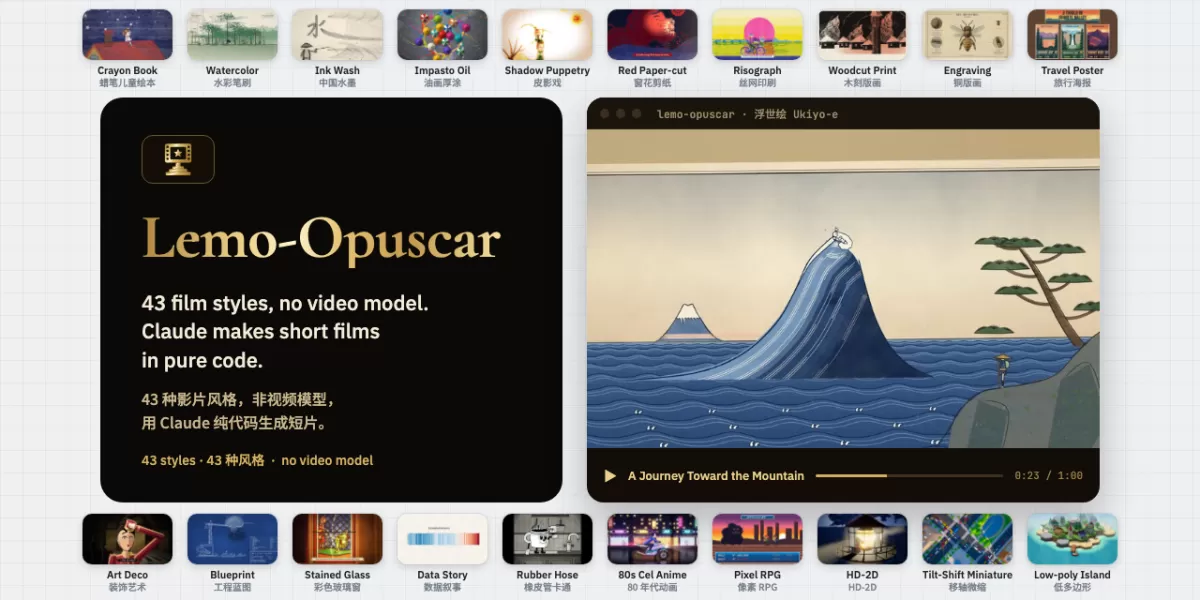
A new open-source project on GitHub offers a way to make short films without a conventional video generation model. Published by the team at Lemomo under the repository lemo-opuscar, the project is a Claude Code skill that covers 43 film styles. Each style comes with a short demo film built entirely from code by Claude Opus 5.5. The repository's latest addition, OPUSCAR 98, applies the same approach to all 98 Best Picture winners from 1927 to 2025 in a film running six minutes and 31 seconds.
What the project offers
The repository, as described by GitHub, pairs each film style with three things: a style prompt, a finished demo film, and a set of directing and technical notes. Users can reuse the prompt on their own topics, so the style becomes a starting point rather than a fixed template.
The OPUSCAR 98 release is the most detailed part of the package. For each Best Picture winner, it lists whether the style is 2D or 3D, provides a representative frame, and includes the style prompt and the way the shots were directed. According to the repository, the breakdown is 77 films in 2D, 4 in 2.5D and 17 in 3D. The same information is available on the film's page and as a JSON file, which makes it easier for developers to build on the data.
The creator states that every film in the project was directed, drawn, scored and mixed by an AI agent writing code. The rendering relies on canvas and WebGL pages that are drawn frame by frame. Music comes from free sample libraries, and narration uses text-to-speech. The project says it uses no video generation and no stock footage.
How it works in practice
Setting up the skill
The recommended route is to install the skill as a Claude Code plugin. Once installed, it can be used from any folder. On first use, it downloads its guides, tools and style prompts into a shared library at ~/lemo-opuscar, which all of a user's films can draw on. Each film's project, from source material to finished video, is saved in the folder where the user started. Users who prefer a different setup can clone the repository instead, in which case films are placed in films/<name>/ inside the repo. For other agents, the repository notes that the skill folder can be copied into their own skills directory.
Directing a film with an agent
The workflow is conversational. A user describes the film they want, including its length, style and any details about the subject. The example in the repository asks for a 45-second film in a watercolour style about a family coffee farm, with a warm female narrator. Styles can be named in English or Chinese, and the repository includes an index of all of them.
Before production starts, the agent asks one set of questions. It checks anything it cannot decide about the topic, and asks whether the user has their own voice, music or other material. It also asks whether the user wants to see a storyboard first. If the user says yes, the agent pauses once to show key shots in the real style. If not, it moves straight to the finished film.
The agent then reads three guides and works in a way the repository compares to a small studio. The project estimates that a single film takes an agent about 30 to 60 minutes, and it notes that the process uses a fair amount of tokens. That cost is worth knowing before starting a long batch of projects.
Why it matters beyond the demos
Most public discussion of AI video has focused on large models that generate footage directly from text. This project takes a different route. It treats code as the medium, so every frame, cut and sound decision is written as instructions for a program to carry out. For creators, that makes the output more predictable and easier to edit, since changes can be made in the source rather than by regenerating footage.
The approach also has limits, and the repository is candid about them. The styles are tuned specifically for Claude Opus 5.5, and the creator says other models may not reproduce them. Anyone hoping to use the system with a different model should expect to adjust the prompts. The project is therefore best understood as a tightly bound workflow rather than a general-purpose tool.
Requirements, licensing and updates
Users need Node 20 or later, ffmpeg, and Python 3.11 or later, or the uv package manager. The agent installs the remaining dependencies itself. The default output is 1920 by 1080 pixels at 24 frames per second, and other sizes can be requested.
- Install and update through the Claude plugin marketplace, using the lemolab marketplace.
- Uninstall the plugin and delete ~/lemo-opuscar to remove the shared library.
- Report stuck steps by opening an issue on the repository.
The project is released under the MIT licence. Third-party assets used in the demos keep their own licences, which are listed in each demo's CREDITS file. The repository makes clear that users are responsible for the materials they bring into their own films.
Outlook
The project shows how far coding agents can stretch into creative production, and it gives filmmakers a transparent, editable alternative to generated video. Whether its styles travel to other models, and how the community builds on the OPUSCAR 98 data, will determine how useful it becomes. For now, the repository offers a concrete example of an AI-directed short film made without video generation, with the full process open for inspection.
Related: Reduce Claude Code Token Costs With optimAIzr CLI · Anthropic's OSS Scanner Automates Security Checks for Open Source


Comments (0)