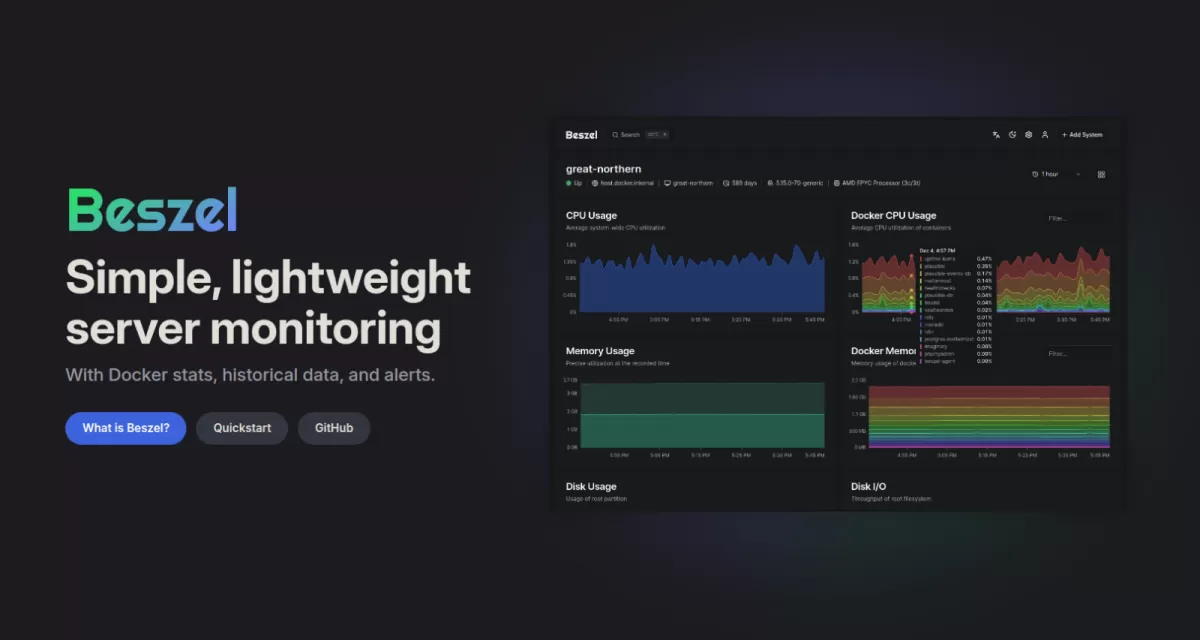
Beszel, an open-source server monitoring project hosted on GitHub, is drawing attention from system administrators who want a simple way to watch their machines without running a heavy monitoring stack. According to the project's GitHub page, the tool combines Docker statistics, historical data and configurable alerts in a lightweight package with a friendly web interface.
What Beszel offers
The project describes itself as ready to use out of the box, with simple configuration and a web dashboard for viewing connected systems. Its feature list covers several areas that small teams and independent operators often need: alerts, container statistics, network checks, disk health reporting and backups.
Beszel says it is smaller and less resource-intensive than leading solutions. That claim comes from the project itself, and it has not been independently measured in the source material. Readers evaluating the tool for production use should test its footprint on their own hardware.
Alerts are configurable for most metrics, and the project says they work with many notification services. Docker statistics track CPU, memory and network usage history for each container, which can help operators spot a service that slowly consumes more resources over days or weeks.
Beyond containers, the project lists network monitoring that measures response time and interruptions directly from its agents. It also reports S.M.A.R.T. disk health data and can send notifications when a drive fails.
Architecture: hub and agent
Beszel is split into two main components. The hub is a web application built on PocketBase, an open-source backend framework. It provides the dashboard used to view and manage connected systems.
The agent runs on each machine you want to monitor. It collects system metrics and sends them to the hub. This split is a common design for monitoring software: a central point shows the whole fleet, while lightweight collectors run where the workloads are.
Multi-user access and authentication
The project supports multiple users. Each user manages their own systems, and administrators can share systems across users. For organisations with several teams, this separation can keep responsibilities clear without requiring a separate installation for each group.
Authentication options include OAuth and OpenID Connect, known as OIDC. The project says it supports many OAuth2 providers and that password login can be disabled entirely. Teams that already run a central identity system can use it rather than managing another set of passwords.
Metrics coverage
The source lists a broad set of metrics. Host and container CPU usage are both covered, along with memory usage, which includes swap and ZFS ARC on systems that use them. Disk usage and disk I/O can be tracked across multiple partitions and devices.
Hardware coverage goes further. The project lists fan speed from Linux host sensors, GPU usage and power draw for Nvidia, AMD and Intel hardware, and battery charge on the host and some peripherals.
Container monitoring is not limited to Docker. The project says it supports Docker and Podman containers and reports their status and metrics. For storage, the project also lists ZFS pool capacity, usage, health, I/O throughput, scrub status and per-dataset usage.
Disk health and RAID arrays
The S.M.A.R.T. feature checks host disk health. According to the project, it also covers eMMC wear and end-of-life indicators, and it can report Linux mdraid array health through sysfs when that information is available. Administrators who run home labs or small file servers often rely on these signals to plan replacements before a failure causes data loss.
Backups and deployment
Beszel includes automatic backups. The project says data can be saved to and restored from disk or S3-compatible storage. That option matters for teams that want their monitoring history to survive a hardware failure on the hub itself.
The project directs new users to its quick start guide and other documentation on its website, beszel.dev. The developer says setup takes only a few minutes, though readers should check the documentation for the requirements that apply to their own environment.
Support, community and licensing
The GitHub page asks users to search existing issues and discussions before opening a new one. The maintainer says he tries to respond to questions but may not always have time. Bug reports and feature requests go to GitHub issues. Support questions and general discussion go to GitHub discussions or a community-run Matrix room.
Beszel is released under the MIT License, which is a permissive open-source licence. The LICENSE file in the repository contains the full terms. That licence allows users to inspect, modify and deploy the software, which is often a deciding factor for organisations with strict compliance rules.
Why it matters
Many operators still rely on a patchwork of scripts, dashboards and manual checks. A single tool that handles container statistics, alerts, disk health and backups can reduce that complexity. The trade-off is that a younger project may have fewer integrations and a smaller community than long-established monitoring platforms, so buyers should weigh the features against their own needs.
Beszel's appeal rests on its simplicity and breadth. The next step for potential users is to review the documentation, test the agent on a non-critical machine and confirm that the notification services and authentication providers they need are supported.
Related: Termix: Free Self-Hosted Server Management Platform Built on Plugins · Open-Source F1 Replay Timing App Brings Live Data to Your Browser



Comments (0)