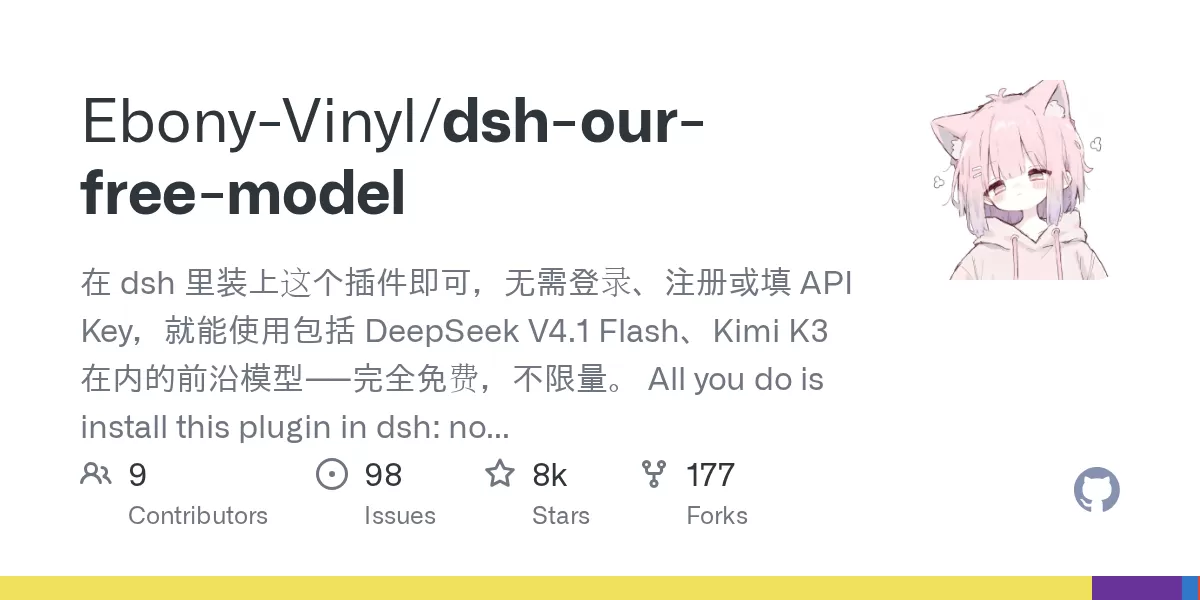
A plugin published on GitHub says it can give users of the dsh application free access to frontier AI models, including DeepSeek V4.1 Flash and Kimi K3, without a login, a sign-up or an API key. The project, hosted in the repository Ebony-Vinyl/dsh-our-free-model, describes the offering as free and without a usage cap. The repository's description was published on 11 October 2026, and its claims come from the project itself rather than from the model developers or the platforms it uses.
What the plugin says it does
According to the repository, users install the plugin inside dsh, and the models then appear in the selector without any further setup. The README is written in both Chinese and English and describes the model list as refreshed from upstream providers at each update, rather than stored as a fixed snapshot.
The project also says it tests availability from the user's own network connection. Models that the upstream gateway explicitly refuses to route are removed from the selector and kept in a settings page with the reason noted. Temporary failures, such as server errors, rate limits and timeouts, are not treated as proof that a model is unavailable.
The plugin includes several other features that go beyond basic access:
- A thinking-effort setting with three levels, Light, Balanced and Deep, which the project says sets a real output token budget rather than a prompt instruction.
- A local OpenAI-compatible and Anthropic-compatible gateway so other tools on the same machine can call these models.
- A fallback feature that lets users chain models together so that a failed request moves to the next model before any answer text has been sent.
- An in-app update process with checksum verification and automatic rollback if a step fails.
- A local usage dashboard that the README says keeps all data on the user's machine.
Several access channels in one plugin
The README lists several routes. The free lane relies on the public gateways of OpenCode and Kilo AI, which the repository says are reached directly, without a third-party relay. A separate channel, available only in certain desktop applications, is described as requiring a GitHub login and a star on the repository before conversations are allowed to proceed.
The project also lists thirteen account-based channels that it says work out of the box. These include tools linked to Huawei Cloud, Tencent, Youdao, Alibaba, ByteDance, iFlytek, SenseTime, Zhipu and Google. The README says these channels keep their own login flows and daily credit systems, and that credentials are stored in the host application's credential store.
Context and the limits of the claims
The phrase "no usage cap" is the most eye-catching claim, and it is the one that readers should weigh most carefully. The repository does not show independent testing of capacity, pricing or continuity. The project itself says that availability depends on each user's network location and on upstream services that can change at any time. In other words, the promise of unlimited use is only as stable as the gateways behind it.
The README also contains a privacy warning. It states that prompts sent through the Kilo free pool may be recorded by the upstream provider to improve its service, and it advises users not to send sensitive content through that route. Anyone considering the plugin for work involving confidential code, client data or personal information should read that section before installing it.
Questions about terms of service are also relevant. The plugin describes access to accounts and free tiers from many companies. The repository does not show whether those companies have approved this kind of routing, and readers should not assume that a tool which works technically is permitted under each provider's rules.
Sharing access across a network
The plugin offers an optional local network relay, which is off by default. When enabled, it binds to an address that other devices can reach and requires a separate key. The README warns that anyone with that key can use the host machine's free quota, so it should only be enabled on trusted networks, ideally with firewall limits on which network ranges can connect.
What to watch next
The project is new, and its main claims have not yet been tested by a wide group of users or independent reviewers. Key questions include whether the free gateways keep their current terms, how long the account-based channels remain usable, and whether the upstream providers respond to this kind of access.
For now, the repository is best read as a developer's description of a tool, not as a confirmed source of free AI capacity. Users who want to try it should start with non-sensitive tasks, keep an eye on the privacy notes, and check the terms of each underlying service before relying on it.
Related: Codex on Crack Lets You Mix Claude and DeepSeek Models in Codex · ClearAI Plugin Builds Verified Domain Ontologies From Research




Comments (0)