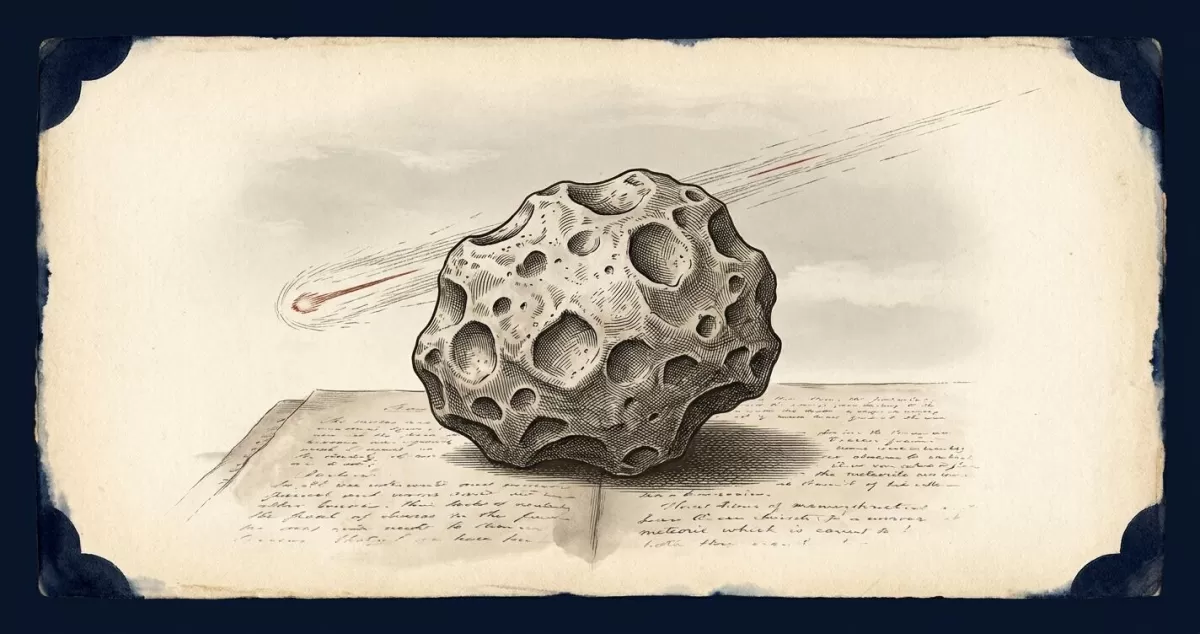
A software engineer says he used AI tools to search centuries of historical records and uncovered a forgotten meteorite fall, three rhinoceroses that never reached their intended recipient, and, according to the headline of his post, several volcanic eruptions that were never recorded. The account, published on the blog of Jesse Waites, is preliminary. The author says each finding still needs review by specialists. Even so, it offers a clear example of how machine search can reopen archives that researchers have never had the time to read in full.
Following a historian’s dodo discovery
The project grew out of a post by the historian Benjamin Breen, published on October 1, 2026. Breen used an AI model to search digitized records of the Dutch East India Company, known as the VOC. The company dominated the spice trade and ran a network of ports across Asia from 1602 until it collapsed under debt and was dissolved in 1799.
Breen’s search relied on GLOBALISE, a project that has converted millions of the company’s handwritten pages into searchable text. Among them, he located a 1615 ship’s journal describing sailors on Mauritius catching many tortoises and dodos. The entry offered a new eyewitness record of the extinct bird, one that had been sitting in the archive for four centuries.
Waites read the article and decided to extend the method. Rather than a single question, he wanted to search many historical mysteries at once and chain several AI models together to filter results and automate the slow, manual steps that usually consume researchers’ time.
Building a pipeline that searches by meaning
Waites began by asking an AI research assistant which open historical questions could be answered with data already online. The tool returned thirteen candidates. Waites ranked them by how complete the data was, whether others had already tackled them, and, most importantly, whether each answer could be checked against an original document.
The reading material was substantial. It included the GLOBALISE transcriptions, which cover about 4.35 million pages dating from the 1600s to the 1790s, the Dutch national library’s digitized newspapers, two centuries of American newspapers, and several ship logbooks. Reading the company pages alone at two minutes each would take a person roughly seventy years, according to Waites’s estimate. His setup completed the company archive in one overnight run.
Spelling was a major obstacle. Old handwriting and print produce text-recognition errors, and seventeenth-century Dutch spelled “rhinoceros” in roughly fifteen different ways. Waites therefore used a system that represented each passage by its meaning rather than its exact words, which allowed searches to catch relevant passages regardless of spelling.
Filters, controls, and human judgment
Even meaning-based searches can return tens of thousands of hits. Waites used a small, fast model to make the first pass, asking narrow questions such as whether a passage mentions a real animal, whether it is wild, and where it took place. Only the passages that model flagged went to a larger model for close reading, translation and extraction of dates and places. Waites said this combination was far cheaper and faster than having the larger model read everything.
Before trusting any negative result, he tested the pipeline on events already known to historians. These included Breen’s dodo, the Laki eruption of 1783 and the Tambora eruption of 1815, along with a dozen others. Waites compared the process to burying a wristwatch in a yard to check that a metal detector works before searching for treasure. The known events were found, and the search moved on to new questions.
Waites also stressed that he remained closely involved throughout. He chose which leads to pursue, which sources to add, and when to stop. In his words, this was AI-assisted research rather than an autonomous investigation.
A meteorite that history forgot
The first significant find came from a newspaper printed in Batavia, present-day Jakarta, in 1812. At that time Britain, not the Netherlands, administered Java, a period that lasted from 1811 to 1816.
In December 1812 the English-language Java Government Gazette reprinted a letter from the Bombay Gazette. The letter was written by an officer with a British force camped near Pandharpur, in what is now Maharashtra. It described a stone that fell from a thunderstorm on August 6 near a village called Cokurrgaum. The officer estimated its weight at around four pounds, noted that it was heavy and rich in iron, and described a thin black crust. The sound of the impact resembled gunfire, and the stone had buried itself about a foot deep in an open field.
The letter never uses the word “meteorite,” which barely existed in English in 1812. Waites argues that this is why keyword searches miss such reports. The pipeline found it because the description matched the pattern of other meteorite falls, whatever vocabulary the writer used.
Waites reports that he checked the find against six catalogues, from Chladni’s list of 1819 to today’s Meteoritical Bulletin, and found no entry for it. He also searched about a hundred digitized periodicals from 1812 to 1817 and found no follow-up report. If confirmed, he says, the fall would be the earliest recorded meteorite in Maharashtra, predating the current earliest record by 26 years.
Rhinos that never reached the king
The second thread concerns animals. In 1738, Company workers near Batavia captured a live Javan rhinoceros as a gift. Each year the Company sent gifts to the King of Kandy, the ruler of the highland kingdom in Sri Lanka, whose goodwill helped secure the cinnamon trade. The king reportedly favored large and impressive animals.
The rhinoceros reached Colombo but never reached Kandy. Company accounts record that it died in 1738, and the governor in Colombo reportedly offered a Persian horse as a substitute. In 1740 the ship Loverendaal sailed from Batavia carrying two rhinoceroses. Within days, the crew’s officers gave sworn statements that the male had died at sea, and a later statement recorded that the female had died as well.
The letters also describe the governor sending pigs and expressing regret over the loss. Three years later, Dutch envoys in southern India were asked to arrange a young rhinoceros for another ruler, showing how sought-after such animals had become.
Waites notes that the Javan rhinoceros now survives only in Ujung Kulon National Park, at the western tip of Java. Records of captive Javan rhinos are extremely rare, and he argues that these documents add three animals to the known record. He has not yet confirmed whether the specialist literature already includes them.
What happens next
Waites’s results will need verification from historians, archivists and natural history specialists before they can be treated as established. His method, however, points to a broader shift. Archives digitized over the past decade can now be searched by meaning, and small teams can read at a scale that once required a generation of scholars. The real test will be whether the leads he has identified survive expert scrutiny and whether other researchers adopt similar workflows.
Related: AdHelm: Free Local CLI Lets AI Agents Audit Your Ad Accounts · AI Agents Decompiled a Shooter: Lessons From 500+ Billion Tokens





Comments (0)