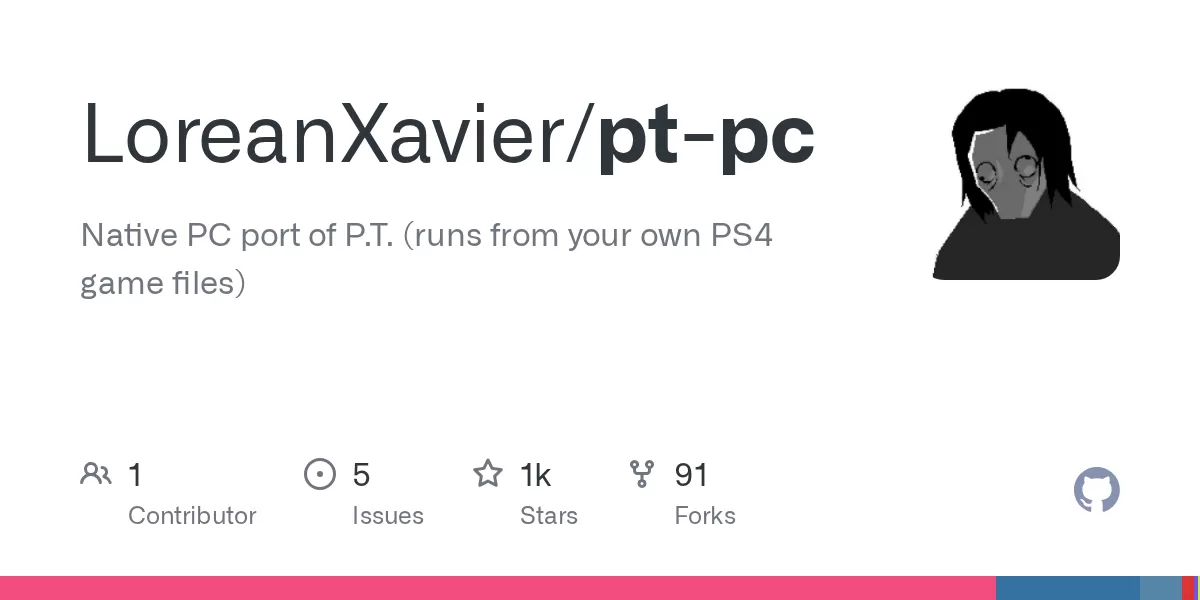
A fan-made native PC port of P.T., the playable teaser released in 2014 by Kojima Productions for PlayStation 4, has been published on GitHub under the project name pt-pc. The port lets players run the teaser on Windows, Linux and macOS, but it works only if users supply their own copy of the original PS4 game files. Its author says the project exists so that the game remains playable outside of consoles that still have it installed.
What the project is
According to the project page on GitHub, this is not an emulator. The game logic was rebuilt in C++ based on the behaviour of the original, and the renderer is written for Vulkan, a cross-platform graphics interface. Every level, model, texture, sound, script and cutscene is read at run time from the player's own copy of the game. The repository contains no game data, and the installer does not include any either.
The author states that the whole teaser can be played from the first wake-up to the street, including the voice segment. The project was developed in the author's spare time and, as the disclosure on the page explains, with help from AI tools used mainly for coding, debugging and testing. The disclosure also says that optional enhanced textures use machine-learning upscaling applied to existing textures.
What players need before installing
The port is built and tested with the US release of the game, identified as CUSA01127. Players can use a dump folder taken from their console or a fake PKG made from that dump. The author says the European and Japanese releases install as well, with a note, but that these versions have not been tested directly. A standard store PKG cannot be used, because it is encrypted for the console that owns it and the project does not decrypt it.
The minimum system requirements listed on GitHub are:
- Windows 10 or 11 on 64-bit x64 processors
- Linux on x86-64 with glibc 2.38 or newer, such as Ubuntu 24.04, Debian 13 or Fedora 39
- macOS 14 or newer, on either Apple silicon or Intel Macs
- A graphics card and driver that support Vulkan 1.3
On macOS, the port uses MoltenVK, a layer that runs Vulkan on Apple's Metal graphics system. Optional ray-traced shadows, ambient occlusion and reflections require a GPU with Vulkan ray queries, a feature the project says is unavailable on macOS. NVIDIA's DLSS upscaling needs a GeForce RTX card, while AMD's FSR and Intel's XeSS run on recent GPUs, though the page says the FSR and XeSS options are Windows only.
One part of the game uses a microphone, as the PS4 version did. Players without one can assign a key under the voice section of the configuration file, and the project says a keyboard key can stand in for the spoken word.
Installation across platforms
On Windows and Linux, the project offers a setup program that asks for the location of the dump folder or fake PKG and for a destination folder. The installer copies the three game archives the port needs and can create a desktop shortcut that uses the icon from the user's own copy. Portable versions are also available for users who prefer to unpack the files and run them from any writable folder.
On macOS, users download a zipped application for either Apple silicon or Intel. Because the app is not signed with a Developer ID, the page explains that users must allow it manually under the system's privacy settings. Fake PKG files must be extracted on Windows or Linux before they are used on a Mac. The author notes that the Intel build has not yet been run on an Intel Mac.
Features beyond the original
The project says that all extras are switched off by default, so the game looks and behaves like the original PS4 version unless a player changes the settings. The optional features include:
- Windowed, borderless or exclusive fullscreen modes, with adjustable render resolution
- Upscaling through AMD FSR 3.1, NVIDIA DLSS 4.5 and Intel XeSS, plus native-resolution anti-aliasing
- Frame generation, limited to recent AMD and NVIDIA graphics cards
- Graphics presets, from Low to Ultra, and a Custom option for individual controls
- A photo mode with camera controls and export at native resolution or 4K
- A speedrun timer with splits at each loop and a connection to the LiveSplit timing software
- Experimental VR support through OpenXR, which the author says has only been tested against a simulated runtime
The port also adds menu and subtitle translations in several languages beyond the original set, including Turkish, Russian, Arabic and Polish. The voice audio remains in the original English, and the word the microphone listens for is always Jack. A mods folder allows players to replace files and run Lua scripts that respond to game events.
Credits, rights and what comes next
The project page credits several contributors. These include a developer for the Apple silicon port, translators for Czech and Polish, and a contributor who made Linux library-loading and startup-focus fixes. The author also thanks the developers of the shadPS4 emulator, whose work was used as a reference for how the original behaves on PS4 and for comparing frames.
The page makes clear that P.T. is the work of Kojima Productions and is owned by Konami. The project states that it is not affiliated with, endorsed by or connected to either company, contains none of their assets and does nothing without a legitimate copy of the game. The port's own code is released under the MIT license, while third-party components keep their own licences.
The GitHub page also invites support through a Patreon page to fund testing hardware and future releases. For readers, the key question is whether the project continues to be maintained, since its value depends on ongoing testing across different consoles, operating systems and graphics cards. The coming releases will show how far the port's compatibility extends beyond the US release it was built on.
Related: Open-Source n8n Bot Calculates Czech Tax on Broker Investments · Software License Renewal Tracker Sends Timely Reminders





Comments (0)