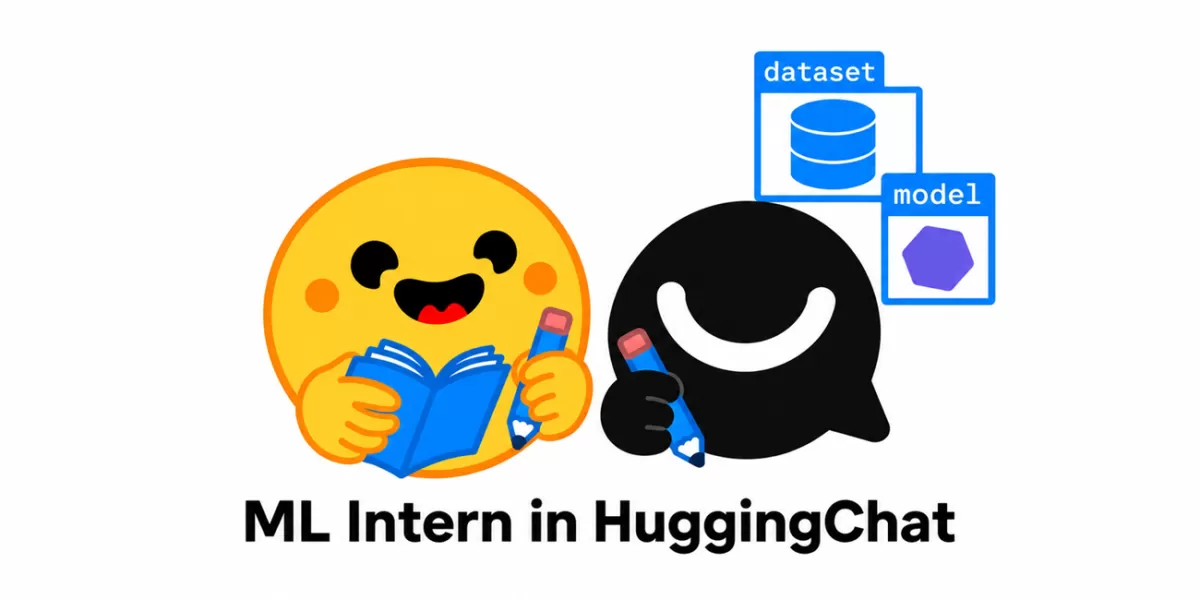
A developer writing on the Hugging Face blog says they built seven custom AI models in a matter of days, using an agent called ML-Intern inside HuggingChat. Each project began as a single chat message and ended as a public model on the Hugging Face Hub, complete with an evaluation in its model card. The post, published on the company's site, makes a practical argument: the hard part of building a model is no longer the hardware but describing the job clearly enough for an agent to carry it out.
How the agent works
According to the post, ML-Intern does more than run a training script. It plans the work, asks the user for a budget before spending anything, runs a small test before committing to the full job, and then trains, evaluates and publishes the result on Hugging Face infrastructure. The author stresses that the agent starts every task with a zero-dollar budget, so paid jobs cannot begin until the user approves a limit.
That design matters for anyone who has worried about runaway cloud bills. If a user does not state a budget, the agent proposes a couple of options based on project size and asks which one to take. The author's examples show spending caps as low as USD 12 for a single project.
Writing the prompt that does the heavy lifting
The author says most of the effort goes into the first message. The opening prompt for the first project ran to about 450 words, while the sixth had grown to nearly 2,000, because each finished project taught the author what to include next. All seven prompts are published in a public GitHub repository under the account yvrjsharma, which the post presents as a resource for other users.
A good prompt, in the author's account, starts with the idea in one line and the reason behind it, then names the exact dataset, base model and training script. Anything the user has already verified goes under a section labelled as facts not to re-derive, so the agent does not spend its budget rediscovering known information.
Two instructions stand out. The first asks for a baseline score on the base model before any training begins. Without it, the author notes, a user ends up with a trained model and no way to tell whether it improved on the starting point. The second asks for a smoke test with a built-in check: for image models, the author requested 50 training steps and a confirmation that the saved weights had actually changed before the full run was paid for.
Four projects, four different problems
A vision model for citrus disease
A general vision model can describe a yellowing leaf, but it struggles to tell a mite infestation from a magnesium deficiency or to recommend treatments. The author assembled a dataset of 3,017 annotated images covering 21 pests, diseases, nutritional gaps and treatments, drawing on three sources hosted by the Project-AgML organization. ML-Intern fine-tuned the Qwen3.5-2B model on these examples.
On a set of 335 test photos, the base model identified the correct problem 14.9% of the time. After two epochs on a single A10G GPU, the fine-tuned version reached 52.8%, more than tripling its accuracy. The compute bill for that run was about USD 1.90.
A model that learns a cartoon character
The second project tackled a niche request: a LoRA, a lightweight add-on for image models, that can draw Huggy, the mascot drawn in the flat style of Hugging Face's brand assets. The author trained it on FLUX.2 klein base 4B using 84 captioned drawings. The agent saved a checkpoint every 100 steps and generated the same test prompts with each one, which made it easier to pick the best version.
Step 200 was the first checkpoint where Huggy looked fully on-model. Beyond step 500, however, the cartoon style began leaking into prompts that had nothing to do with the character. The author reports that the finished add-on also works on the faster distilled version of the model at four steps, for about USD 7.60 in compute.
Camera angles and doodle edits
Camera-angle LoRAs have been popular community add-ons for earlier Qwen-Image models, letting users ask for a view of an object from a different side. When the author checked shortly after the Qwen-Image 2.1 release, no such add-on existed, so ML-Intern was tasked with building one. It rendered 1,030 scanned household objects from Google Scanned Objects at 24 angles each, then assembled 1,844 before-and-after training pairs across 23 camera instructions. Training took about 90 minutes on one A100, and the total project cost about USD 16 across 48 jobs, many of which failed on missing packages or incorrect file paths and had to be resubmitted by the agent.
A second add-on, which the author calls Doodle-in, lets users draw a magenta scribble on a photo and name an object to fill it. No dataset existed, so the prompt described how to build one from Open Images photos, removing an object with the LaMa inpainting model. The agent produced 6,042 training pairs and a 160-pair test set, recording the author and licence of every source photo. Paired with the Viggle turbo LoRA at six steps, the model placed objects where they were drawn in 67.5% of cases, at 4.7 seconds per edit. It performed about as well on 23 object classes it had never seen during training (65.0% against 64.2% for the rest). The project cost about USD 24.
Small models for real devices
The author's fourth project is a pair of models designed to run on modest hardware. The Pocket Rewriter series uses a 9B teacher model to rewrite 8,797 short image requests, covering photos, posters, logos and infographics, with many prompts asking for exact text and many written in languages other than English. After filtering, 1,840 examples were used to train 0.8B and 2B student models. The 0.8B version is also available as an 812 MB GGUF file for running on a CPU. Total compute cost was about USD 16.
A separate experiment shrank Logolabs' Agate Preview 002, a 260M-parameter text-to-image model that normally needs 50 steps with guidance, meaning 100 network passes per image. The first distillation run cut the step count in stages from 16 to 8 to 4, and the resulting four-step student beat the teacher run at the same four steps on the GenEval and FID benchmarks. A second run added 24,000 more image pairs and raised GenEval from 0.509 to 0.536, against the teacher's 0.563 at 50 steps. The author reports the total cost across both runs at about USD 37.
What comes next
The post's central lesson is that clear instructions and cheap experiments matter more than raw computing power. The author recommends starting with a model you wish existed and a dataset you already have or can describe, setting a small budget, requesting a baseline and a smoke test, and reviewing the results before raising the spending cap. For readers curious about agent-driven model development, the published prompts and model cards offer a concrete place to start, and the author invites others to share what they build with the Gradio and Hugging Face accounts on X.
Related: LFM2.5-24B-A2B: Liquid AI's Open Reasoning Model for On-Device Agents · n8n Workflow Parses Gmail Invoices Into Sheets With Slack Alerts




Comments (0)