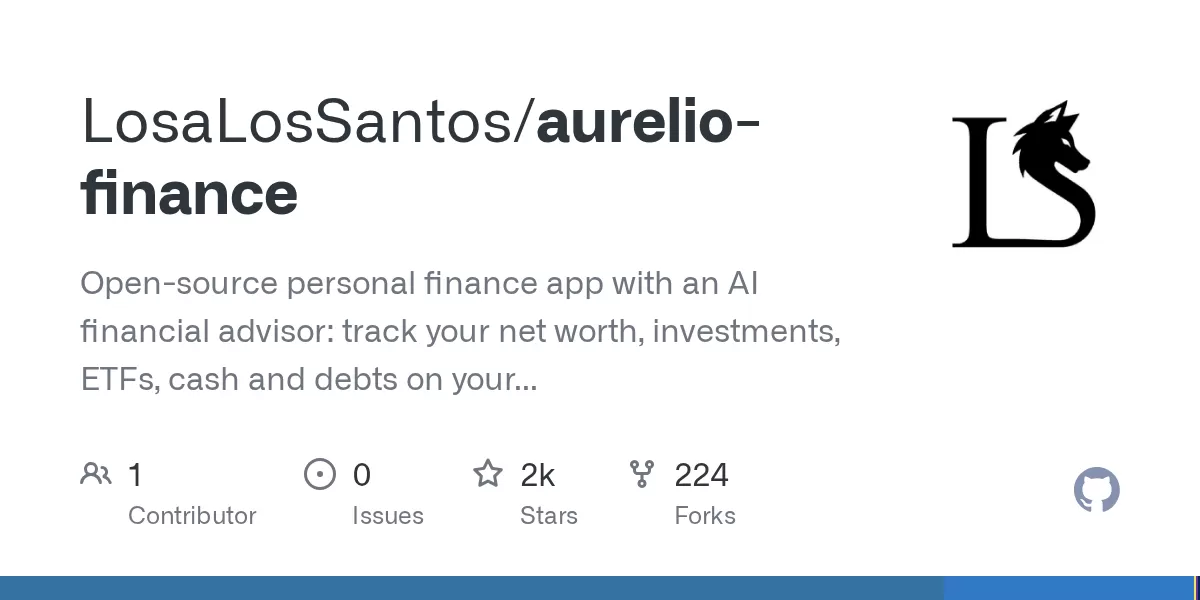
A new open-source personal finance application called Aurelio has been published on GitHub, offering users a way to track their net worth, investments, ETFs, cash and debts on their own computer. The project, listed in the repository LosaLosSantos/aurelio-finance and dated 11 October 2026 by GitHub, combines wealth management and financial planning tools with an AI advisor that users can question in a chat window. According to the project page, the records stay on the user's machine, and the AI feature is optional.
What the app does
Aurelio is described as a wealth-management and financial-planning app. Its features are split into several areas that together cover most of a household's financial picture.
- Wealth: banks and brokers, their cash balances, and dated snapshots of what the user holds.
- Portfolio: every position priced from the market, along with its cost, gain and dividends.
- Look-through: what funds actually hold, broken down by country, sector, company and currency.
- Plans, homes and debts: recurring investments, real assets and the loans used to finance them.
- Cash flow and goals: income, expenses, savings rate and the return each goal requires.
The most distinctive element is a chat called Ask Aurelio. According to the project page, it answers questions based on the user's own records and can search the web. Any proposed change to the data appears as a card that the user must confirm before it takes effect, which keeps the user in control of what is recorded.
The project also includes an analysis feature in which an analyst and a confidant, two AI perspectives, debate the user's portfolio, and a closing synthesis indicates what deserves attention first. A separate section called How Aurelio reasons explains the financial ideas behind the app's suggestions.
Keeping data on your own machine
The central promise of Aurelio is local storage. Records are kept in a file called backend/data.db inside the project folder. The project page notes a safeguard for updates: before a new version changes the database format, the app saves a copy of the existing file next to it. For anyone who has lost data after a software update, that backup step is a practical detail worth reading before installing any new release.
Local storage is a notable choice in a category where many budgeting and investment tools are hosted services. Users who keep their financial data off third-party servers gain more direct control, but they also become responsible for backing up their files and maintaining the software themselves.
Trying the app with invented data
Before entering real figures, the project suggests a demo mode. Starting the app with a demo flag opens a sample household populated with invented data, kept in a separate file from the user's records. The first launch installs the components the app needs inside the project folder and then opens the interface at a local address, http://localhost:8000.
Windows users may encounter a common obstacle. If PowerShell reports that running scripts is disabled, the project page recommends launching the start script with the execution policy temporarily bypassed for that session. Launching without the demo flag switches the app to the user's own data.
Setting up the optional AI advisor
The AI features are not required to use the app. When they are wanted, the project relies on OpenRouter, a service that gives access to a range of AI models. Users must create an account, add credit and generate their own API key. The key is then placed in a configuration file copied from an example template.
The default model is Claude Opus 5.5, which the project page lists at $4 per million input tokens and $20 per million output tokens. Users can choose a different model within the chat. The page also reports costs measured in October 2026 on a test database, covering chat activity on 10 October and a web search on 9 October. Because AI costs depend heavily on how much a user asks and how long the conversations run, those figures should be treated as a reference point rather than a fixed estimate.
Requirements and development
What you need to run it
Running Aurelio requires Git, Node.js version 22 or later, and uv, a Python package and project manager. The project page provides the commands needed to start the app, and the developer section explains how to run the automated test suites for both the backend and the frontend.
For developers
Contributors can run the backend tests with uv in the backend folder and the frontend tests with npm in the frontend folder. For a faster editing cycle, the project supports hot reload, which means the interface updates as code changes without a full restart.
What to watch next
Aurelio is a notable example of a growing group of projects that place personal finance data on the user's own hardware while using outside AI services only when the user chooses to. Its strengths are clear from the project page: local records, a demo mode for safe testing, and a confirmation step before any change is saved. Prospective users should still weigh the setup requirements and the ongoing cost of an AI key against the convenience of a hosted service. One detail to check before adopting it is the license. The License heading on the project page appears without text in the material reviewed, so anyone planning to use or modify the code should confirm its terms directly in the repository.
Related: Atticus Mac Voice Assistant Runs on Your Claude Plan, No API Key · Open-Source n8n Bot Calculates Czech Tax on Broker Investments




Comments (0)